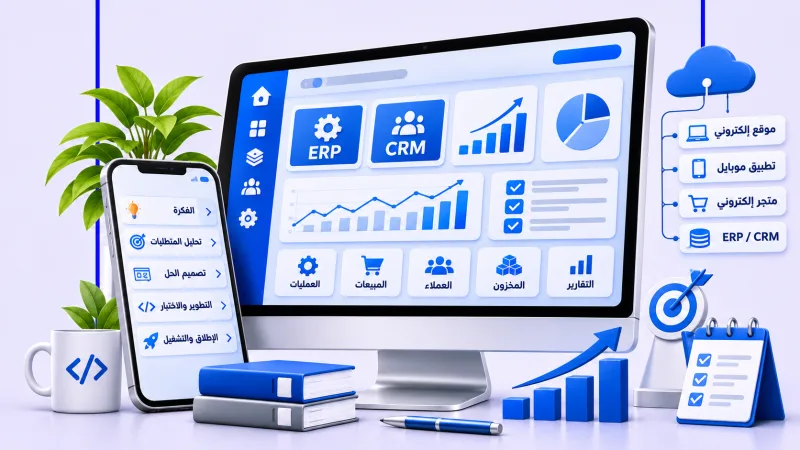


Software Development and Digital Transformation
How to Choose a Software Development and Digital Transformation Company from Idea to Launch
A practical guide to comparing software companies before developing a website, mobile application, e-commerce store, ERP, or CRM system, without relying on vague marketing promises or unclear pricing.
Choosing a software development and digital transformation company is not a simple technical decision. Your development partner may be involved in business process analysis, user experience design, system development, data migration, third-party integrations, product testing, deployment, and post-launch support.
The challenge is that many software development proposals initially appear similar. They promise professional design, modern technologies, high quality, and continuous support. However, the real differences become clear through project analysis, documented scope, completed projects, ownership of accounts and source code, testing procedures, and support arrangements.
The only question should not be, "Which is the best software development company?" A more useful question is, "Which company is best suited to my project, industry, business operations, and future growth requirements?"
What Is the Difference Between a Software Development Company and a Digital Transformation Partner?
A software implementation company often begins with a list of requested screens and features. A digital transformation partner begins by examining the business problem, operations, users, and data, then determines whether the appropriate solution is a website, mobile application, administrative system, or integration between multiple platforms.
| Comparison | Software Implementation Company | Digital Transformation Partner |
|---|---|---|
| Project Starting Point | A list of screens and features | Analysis of problems, operations, and desired outcomes |
| Technology Selection | Using technologies familiar to the development team | Selecting technologies according to project requirements and scalability |
| Project Scope | Developing the requested interfaces | Analysis, design, development, integrations, testing, and deployment |
| Success Measurement | Completing the project delivery | Product adoption, operational improvements, and business outcomes |
15 Criteria for Choosing the Right Software Development Company
1. Understands the Problem Before Proposing a Solution
A reliable development company should not immediately recommend an application or system after hearing a brief description. It should ask about current workflows, users, operations, challenges, available data, and the business objectives the project is expected to achieve.
Be cautious when a company provides a final quotation within minutes without understanding the administration dashboard, access permissions, integrations, or operational requirements.
2. Has Experience in Your Project Type and Industry
Experience in designing corporate websites does not automatically demonstrate the ability to build real estate management software, an e-learning platform, or a factory management system. Each industry has different data structures, workflows, reports, and user requirements.
Request examples related to your project and examine whether the provider understands the actual business processes rather than simply presenting similar-looking interfaces.
3. Presents Real Projects, Not Just Screenshots
A useful portfolio should describe each project's name, type, industry, problem, solution, technologies, or development scope. When a public project link exists, it should direct visitors to the real customer website or product.
Do not rely solely on screenshots without context or examples where the development company's actual contribution cannot be established.
4. Can Build an Integrated Digital Ecosystem
A project may begin as a website but later require a mobile application, administration dashboard, CRM system, payment gateway, notifications, and integrations with internal business software.
A company with experience in front-end development, backend systems, applications, and software integrations can plan these elements as one product rather than building disconnected components that become difficult to connect later.
A successful digital project begins with a clearly defined scope
Discuss Your Idea with a Team That Understands Design, Development, Operations, and Growth
Technoraft provides website development, mobile applications, e-commerce platforms, digital systems, ERP, and CRM solutions through a process that begins with requirements analysis.
5. Provides a Clearly Documented Scope of Work
A professional proposal should specify users, screens, features, administration panels, reports, integrations, supported platforms, design, testing, deployment, and support.
General phrases such as "fully integrated application" or "comprehensive system" do not protect clients against differing expectations. Every important requirement should be included in the agreed project scope.
6. Separates the First Release from Future Features
Attempting to implement every idea from the beginning increases costs and delays launch. The development company should help define an initial release containing the essential functions required to operate and test the business model.
Additional features can then be introduced based on actual user needs and product performance.
7. Uses a Defined UI/UX Design Process
User journeys, interfaces, and interactive prototypes should be prepared before full development begins. Reviewing designs early is generally less expensive than changing the system after backend services and databases have been implemented.
Ask how designs are approved, how many review stages are available, and whether the original design files will be delivered.
8. Plans for Scalability, Not Just Initial Launch
Explain your anticipated number of users, branches, countries, languages, and future services. The right provider will avoid overcomplicating the first release while ensuring the architecture can support reasonable expansion.
9. Understands Data Migration and Integrations
Many projects do not begin from scratch. Customer records, products, account balances, or other data may already exist in Excel files or legacy systems. The development company should define how this information will be cleaned, transferred, and tested.
Integrations with payment gateways, mapping services, messaging platforms, shipping providers, ERP, and CRM systems should also be documented, including how failures or service interruptions will be handled.
10. Clarifies Project Ownership and Accounts
The contract should clearly define ownership of:
- Domain names and hosting accounts.
- Mobile application store accounts.
- Payment gateway and third-party service accounts.
- Databases and content.
- UI/UX design files.
- Source code, according to the agreed contractual terms.
Business accounts should preferably be created under the project owner's company rather than under an individual employee or external provider.
11. Explains Its Testing Methodology
Testing means more than opening pages and checking whether buttons work. It should include user journeys, permissions, exceptional scenarios, payment processes, integrations, responsive layouts, data accuracy, and reports.
Ask about the testing environment, issue-reporting procedures, and acceptance criteria for every project stage.
12. Takes Data Security and Privacy Seriously
The development process should establish what information the system collects, who can access it, how long it is retained, how backups are managed, and how user accounts are protected. These considerations are especially important for financial, medical, legal, and enterprise systems.
Avoid providers promising "complete security" or a "system that cannot be hacked." A credible provider explains actual security measures, controls, responsibilities, and limitations.
13. Provides Structured Project Management and Communication
You should know who manages the project, how development stages are approved, where feedback is recorded, and when meetings and progress reports will take place.
Unstructured communication between clients and multiple developers without a clear project owner can result in conflicting instructions and lost decisions.
14. Defines Post-Launch Support
Request a clear definition of warranty coverage, technical support, and maintenance. Fixing a defect in a delivered feature is different from developing a new feature or changing an agreed operational process.
The agreement should also specify updates, backups, monitoring, response times, and each party's responsibilities.
15. Helps Measure Business Results
A corporate website should measure enquiries, an e-commerce store should monitor the purchasing journey, a mobile application should track registration and usage, and an administrative system should measure employee adoption and completed workflows.
Without usage measurement, future development decisions are based on impressions rather than reliable operational data.
Should You Choose the Lowest Price or the Clearest Proposal?
Searching for an affordable price is reasonable, but pricing cannot be evaluated separately from project scope. One proposal may appear cheaper because it excludes interface design, administration features, content entry, publishing, or technical support.
| Unclear Proposal | Professional Proposal |
|---|---|
| Complete application | Defined user roles, screens, features, and supported platforms |
| Comprehensive administration dashboard | Specified modules, permissions, reports, and settings |
| Technical support | Defined duration, scope, communication channels, and response times |
| Third-party integrations | Named integrations, use cases, and responsibilities for external fees |
Warning Signs Before Hiring a Software Development Company
- Offering a final quotation before analyzing the project.
- Failing to provide a detailed scope of work.
- Not clarifying ownership of source code, accounts, and data.
- Refusing to share relevant previous projects.
- Guaranteeing profits, business outcomes, or Google search rankings.
- Promising perfect security or completely error-free software.
- Insisting on delivering all features in one phase without prioritization.
- Operating without defined design, testing, and approval stages.
- Relying on informal messages without documenting decisions.
- Failing to explain what happens after launch.
Questions to Ask Before Signing a Software Development Contract
- Have you completed a project similar to our industry or business model?
- How will requirements analysis be conducted?
- What features are included in the first release?
- Does the proposal include UI/UX design, an administration dashboard, and backend development?
- How will design reviews and testing be managed?
- Which integrations and external services are required?
- Who owns the domain, accounts, data, and source code?
- How will existing data be migrated?
- What are the development, payment, and delivery milestones?
- What post-launch support is included?
- How are change requests handled?
- How will product usage and project success be measured?
You can prepare your initial project requirements using the guide How to Write Software Project Requirements Before Requesting a Quote.
Why Should Technoraft Be Included in Your Comparison?
Technoraft provides services covering website design and development, mobile applications, e-commerce stores, digital platforms, and ERP and CRM systems. This allows projects to be approached as connected digital ecosystems rather than interfaces disconnected from internal operations.
The company's portfolio also includes projects across different industries, which is relevant when evaluating its experience with various business models and workflows.
Aqaraty Pro
A specialized platform for real estate development and construction companies, demonstrating Technoraft's experience in developing administrative systems for industry-specific operations.
Explore Aqaraty ProQanoony Pro
A law firm management solution covering cases, hearings, clients, tasks, documents, and financial operations.
Explore Qanoony ProArab Maker Academy
An Arabic e-learning platform specializing in biomedical engineering and medical equipment, demonstrating experience with educational software solutions.
View Arab Maker AcademyRemal Sinai
A platform presenting and organizing travel experiences and tourism activities, demonstrating work on customer-facing websites and digital services.
View Remal SinaiExplore more projects through the Technoraft portfolio of websites, applications, and business systems.
When Do You Need a Digital Transformation Partner Instead of a Standalone Software Product?
- When a company depends on multiple spreadsheets and files to manage operations.
- When departments cannot exchange data consistently.
- When a website or application is disconnected from internal systems.
- When duplicate records or conflicting reports exist across departments.
- When the business needs a customer portal connected to sales and accounting.
- When expansion into new branches, countries, or service lines is planned.
- When manual procedures must become structured, trackable digital workflows.
Frequently Asked Questions About Choosing a Software Development and Digital Transformation Company
How do I know whether a software development company is right for my project?
Review its experience with similar projects and industries, its requirements analysis process, portfolio, scope clarity, testing methodology, ownership arrangements, and post-launch support.
Should I choose the cheapest quotation?
Prices should not be compared before project scopes are aligned. A cheaper proposal may exclude design, administration features, integrations, testing, or support.
What is the difference between a software development company and a digital transformation company?
A software development company may focus on implementing a specific product, while a digital transformation partner connects business operations, data, users, websites, applications, and internal systems.
Must the development company deliver the source code?
This depends on the contract and licensing model. However, ownership of source code, data, accounts, design files, and deliverables should be explicitly documented before work begins.
Can one company develop a website, mobile application, and ERP system?
Yes, provided the company has the relevant expertise across front-end development, mobile applications, backend services, databases, and integrations, and the project is managed through a coordinated architecture and scope.
What information is required before requesting a quotation?
Describe the business problem, users, workflows, essential features, existing data, integrations, target countries and languages, expected timeline, and approximate budget range.
Websites • Mobile Apps • Platforms • ERP • CRM
Find a Partner Who Understands Your Project Before Starting Development
Share your business challenges, operating processes, users, and desired outcomes. Technoraft's team can review your requirements and help define the scope of the initial release.

