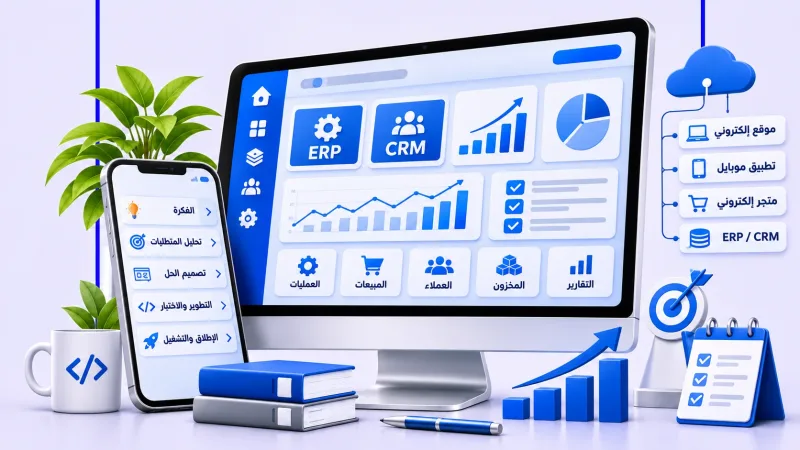


ERP Systems and Digital Transformation
How to Budget for Custom ERP Development for Your Company in Saudi Arabia
A practical guide for business owners and managers looking to move from disconnected files and spreadsheets to a centralized system that connects processes, data, and reports.
There is no single answer to the cost of ERP development in Saudi Arabia, because an ERP project cannot be priced simply as a collection of screens. The actual cost depends on the number of departments, branches and users, workflow complexity, existing data, reporting requirements, integrations, training, and support after launch.
A basic system connecting sales, inventory, and accounting is very different from one managing a construction company with projects, progress payment certificates, suppliers, and multiple warehouses. It also differs from a manufacturing ERP managing work orders, raw materials, and production costs, or a real estate ERP managing developments, units, contracts, installments, and collections.
That is why an accurate budget begins with analyzing actual operations, not choosing the lowest quotation. Implementing an unsuitable system can lead to additional expenses for modifications, data migration, retraining, or even a return to Excel.
What Is a Custom ERP System?
A custom Enterprise Resource Planning (ERP) system is software developed or configured around the company's real workflows instead of forcing teams to adopt unsuitable processes. It is designed to connect departmental data so that an action in one area can automatically update related activities elsewhere.
For example, approving a sales order might reserve inventory, generate an invoice, record an amount receivable, and update sales reports. Approving a purchase order might update supplier obligations, inventory, and expenses according to the company's rules.
10 Key Factors That Determine ERP Development Cost
1. Number of Departments and Modules
Every additional module introduces screens, workflows, permissions, and reports. A project might begin with sales, customers, and inventory before expanding to purchasing, accounting, human resources, projects, maintenance, fixed assets, and customer service.
However, not every company needs every module. Prioritize the departments that address the most pressing business problem, and add the remaining modules in later phases.
2. Industry and Operational Workflows
Real estate, construction, manufacturing, trading, legal services, education, and healthcare operate differently. Even companies within the same industry can have different approval processes, pricing structures, collection methods, and responsibility assignments.
A distribution company needs functionality for branches, sales representatives, inventory, and returns. A garment factory might require production orders, raw materials, sizes, manufacturing stages, and actual cost calculations for every order.
3. Users and Branches
Number of users affects infrastructure, licensing, support, and training, but user count alone does not determine cost. The diversity of roles, permissions, and transactions processed simultaneously is often more significant.
A single-branch business is simpler than a company with financially independent branches, multiple warehouses, or subsidiaries requiring both individual and consolidated reports.
4. Permissions and Approval Workflows
A business may require approval from a department manager before a finance manager, different spending limits for each role, or a separation between employees who create, review, and approve transactions.
More approval levels, exceptions, and notifications mean more analysis, development, and testing to ensure the platform neither interrupts operations nor provides inappropriate access.
5. Accounting and E-Invoicing in Saudi Arabia
If the ERP includes invoicing and sales, the company must review applicable accounting and tax requirements. The second phase of Saudi Arabia's electronic invoicing program is known as the Integration Phase, implemented in stages for taxpayer groups announced by the Zakat, Tax and Customs Authority (ZATCA).
Adding an invoice template or a QR code alone may not be sufficient. The project scope must establish whether actual integration with the Fatoora platform is required, along with the applicable data formats, fields, and technical scenarios.
See the official ZATCA e-invoicing rollout phases for the authority's published information.
6. Migrating Legacy Data
Company records may be distributed across Excel files, accounting applications, and legacy databases. They should be reviewed before being imported into the new ERP system.
Migration includes checking duplicates, missing fields, product and customer codes, opening balances, and relationships between records. Poorly structured data can make migration more complicated than developing some of the system's screens.
7. Integrations with External Systems
An ERP may need to connect with an e-commerce store, mobile application, payment gateway, attendance platform, shipping service, SMS or email provider, bank, or existing accounting software.
Integration cost depends on the quality of the third-party API, available information, usage limits, and error-handling processes when a connection fails.
8. Reports and Dashboards
Some businesses request numerous reports without defining the decisions those reports will support. It is better to identify the key metrics for each department, such as sales, collections, inventory, costs, project profitability, and cash flow.
A simple report is different from an interactive dashboard with filters, comparisons, branches, time periods, and separate permissions for different users.
9. Cloud Hosting or On-Premises Servers?
Hosting choices affect infrastructure, administration, backups, monitoring, and updates. Cloud systems can simplify access from branches, while some industries may have specific requirements related to data location or regulatory controls.
The choice should account for the company's data, users, industry, and risks rather than initial price alone.
10. Training and Post-Launch Support
An ERP project does not succeed simply because the software is deployed. Employees need training, operating documentation, support during initial adoption, and clearly defined arrangements for maintenance, updates, and future enhancements.
Ready-Made ERP or Custom Development?
| Comparison | Ready-Made ERP | Custom ERP |
|---|---|---|
| Getting started | Faster when existing workflows match the platform | Requires analysis, design, and development |
| Initial cost | Often lower, depending on subscriptions | Typically higher, depending on customization scope |
| Workflow fit | Limited to supported platform capabilities | Designed around company processes |
| Updates and maintenance | Usually handled by the solution provider | Defined in a support and development agreement |
| Best fit | Companies with relatively standard requirements | Companies with specialized operations and approvals |
Customization does not always mean building an entire system from scratch. The best solution may be a standard ERP with limited configuration, an industry-specific product, or a set of custom modules around an existing platform.
ERP Purchase Price vs. Total Project Cost
The initial quotation is not the only expense to consider. Total cost of ownership and implementation can include:
- Business process analysis and requirements documentation.
- User experience and interface design.
- Module and feature development.
- Hosting or infrastructure.
- External licenses and subscriptions.
- Cleaning and migrating historical data.
- System integrations and third-party services.
- Testing and issue resolution.
- Employee and management training.
- Technical support, maintenance, and updates.
- New features developed after launch.
How to Get Comparable ERP Quotations
Do not compare two numbers until you confirm that both proposals cover the same scope. A lower quotation may exclude data migration, training, e-invoicing, support, or required reports.
Each quotation should specify:
- Included modules, screens, and workflows.
- Major user roles and permissions.
- Approval flows and exceptions.
- Reports and management dashboards.
- Data cleaning and migration scope.
- External integrations and providers.
- Invoicing and technical compliance requirements.
- Hosting and backup provisions.
- Implementation and delivery milestones.
- Training and technical support.
- Ownership of data, source code, and accounts.
Industry-Specific Systems Developed by Technoraft
Aqaraty Pro
A specialized platform for real estate developers and construction companies, connecting projects, properties, customers, contracts, collections, accounting, inventory, and reports.
Explore Aqaraty ProQanoony Pro
A law firm management system that brings legal cases, hearings, clients, documents, tasks, finances, employees, and reports together in one platform.
Explore Qanoony ProMistakes That Increase ERP Implementation Costs
- Starting development without documenting current workflows.
- Requesting every feature in the first release.
- Frequently changing requirements after coding begins.
- Failing to appoint an internal project decision-maker.
- Migrating data without cleaning or validation.
- Ignoring the employees who will actually use the ERP.
- Not testing real-life workflows and exceptional scenarios.
- Neglecting training and change management.
- Choosing the cheapest offer without comparing scope.
- Failing to agree on post-launch support and development.
How to Prepare Your Company Before Requesting an ERP Quote
- Identify the problems the ERP should solve.
- List the departments and branches that will use it.
- Document the main processes in each department.
- Define who creates, reviews, and approves each transaction.
- Prepare examples of the reports you currently use.
- List the software and files currently in use.
- Assess the quality of data that must be migrated.
- Identify integrations and invoicing needs.
- Split the project into an initial release and later phases.
- Request a proposal covering scope, timeline, training, and support.
Frequently Asked Questions About ERP Costs in Saudi Arabia
Is There a Fixed Price for ERP Development?
No. Cost depends on modules, users, branches, reports, approval workflows, data migration, integrations, training, and support.
Which Is Better: Ready-Made or Custom ERP?
A ready-made platform can work well when its processes match the business. Custom ERP is more appropriate when a company has workflows, approvals, or reports that standard software cannot adequately support.
Can Excel Data Be Migrated into ERP?
Yes. The files should first be analyzed, records cleaned, fields and codes standardized, and the historical data that needs to be retained identified.
Can ERP Support Electronic Invoicing?
Yes. An invoicing module can be developed or connected in line with the applicable requirements, but the integration scope, required fields, and technical scenarios must be defined first.
How Long Does ERP Development Take?
Timelines depend on system size, requirements clarity, existing data, integrations, and review cycles. A phased release can reduce the risks of implementing every department at once.
What Information Is Needed for an ERP Quotation?
Describe the company's industry, departments, branches, users, current workflows, reports, legacy data, integrations, and priority features.

