

Managing a garment factory involves much more than recording sales, purchases, and warehouse balances. The operating cycle begins with styles, quantities, materials, and work orders, continues through production and inventory movements, and ultimately affects costing, sales, accounting, and management reporting.
This is why garment manufacturers can benefit from a specialized ERP system for garment factory management that connects operational data instead of distributing it across spreadsheets, paper records, and disconnected applications.
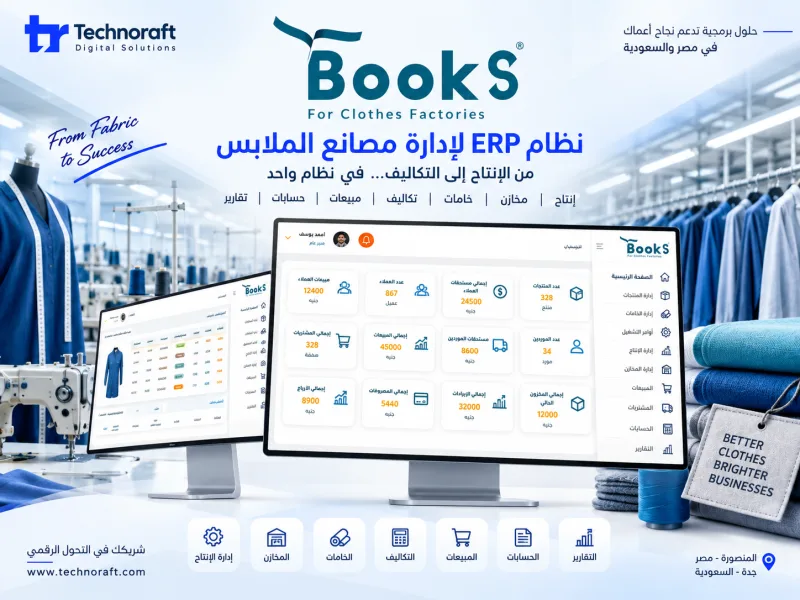
BookS – For Clothes Factories is a Technoraft ERP project designed around this concept, connecting key factory operations within a centralized digital management environment.
Why Do Garment Factories Need a Specialized ERP?
Purchasing, warehouses, production, sales, and accounting do not operate independently. Materials used in production affect inventory and costing, while production results influence sales availability and financial data. A connected ERP creates a shared operational data flow between these areas.
What Is the BookS Garment Factory ERP System?
BookS is an ERP project developed to organize key garment manufacturing operations, including planning, work orders, materials, warehouses, production, costing, accounting, sales, and management reporting.
Explore the implementation in the Technoraft Garment Factory Management System portfolio project .
Replacing Disconnected Factory Data
Problems appear when purchasing uses one file, warehouse teams use another, production maintains separate records, and accounting later attempts to combine everything to calculate costs.
ERP provides a common data environment so operational information can move between departments without repeatedly rebuilding the same records.
Production and Work Order Management
Manufacturing organization begins with identifying styles, quantities, sizes, and production requirements. Structured work orders create a reference point that can be connected with materials, inventory movements, production activity, and costing.
Garment Material Management
Fabrics, threads, accessories, and other manufacturing materials represent an important part of production costs. Connecting material data with production and work orders gives management a clearer view of requirements and actual consumption.
Warehouse and Inventory Management
Inventory management should provide more than a current balance. Businesses also need visibility into receipts, issues, transfers, and the operational reasons behind inventory movements.
Develop an ERP System Around Your Actual Business Workflow
Technoraft develops custom ERP, administrative, and financial systems based on real workflows, departments, users, permissions, and reporting needs.
Explore Software Development ServicesProduction Tracking
A centralized ERP gives management a structured way to follow production data and work orders instead of depending entirely on calls, messages, and manually consolidated reports.
Garment Production Costing
One of the most important reasons for implementing a garment factory management system is gaining clearer production-cost information.
Connecting materials, inventory movements, production orders, and financial data provides a better foundation for cost analysis than relying on disconnected departmental records.
Connecting Sales, Inventory, and Production
Sales demand affects planning, production determines available quantities, and inventory influences order fulfillment. Connecting these operations provides management with broader visibility across the business cycle.
Accounting and Financial Operations
Integrating operational and accounting information can reduce the need to repeatedly re-enter and manually consolidate data between purchasing, inventory, production, and finance.
Dashboards and Management Reports
The value of operational data increases when it can be transformed into reports and indicators that help management review production, inventory, costs, sales, and financial performance.
ERP vs. Excel for Garment Factory Management
Excel remains valuable for many forms of analysis, but complexity increases when core factory operations depend on dozens of separate spreadsheets maintained by different users.
ERP provides a shared database and operational workflow, while Excel can continue to support selected analysis tasks when needed.
Who Can Benefit from a Garment Manufacturing ERP?
The approach can serve ready-made garment factories, uniform manufacturers, and businesses handling multiple styles, sizes, quantities, materials, production orders, and inventory movements.
Custom ERP or Off-the-Shelf Software?
Standard software may fit businesses with straightforward requirements. However, specialized or custom ERP becomes more relevant as production workflows, permissions, reporting structures, and integrations become more business-specific.
The goal should not simply be selecting the product with the largest feature list. The system should represent how the company actually operates.
Software and ERP Development in Mansoura and Egypt
Businesses searching for a software development company in Mansoura or an ERP development company in Egypt should evaluate more than interface design.
Understanding workflows, departments, permissions, data relationships, reports, and future scalability is fundamental when developing business management software.
Technoraft Digital Solutions develops ERP and CRM systems, websites, mobile applications, and custom digital solutions for different business requirements.
ERP and Software Development in Jeddah and Saudi Arabia
Companies in Saudi Arabia may require systems capable of supporting growing teams, operations, branches, permissions, and reporting requirements.
When looking for a software development company in Jeddah or custom ERP development in Saudi Arabia, businesses should begin by defining operational requirements before selecting or developing the system.
Why Develop Custom Business Systems with Technoraft?
The process begins with understanding business requirements and workflows, followed by experience design, software development, testing, integrations, permissions, reporting, and preparation for future expansion.
Need an ERP System Built Around Your Factory Workflow?
Share your departments, workflows, and operational requirements with Technoraft to define the appropriate modules, permissions, reporting, and project scope.
Frequently Asked Questions
What is a garment factory ERP system?
It is a business management system designed to connect factory operations such as work orders, materials, inventory, production, costing, sales, accounting, and management reporting.
Can ERP replace Excel?
ERP can reduce dependence on disconnected spreadsheets by centralizing data and workflows, while Excel can still remain useful for selected analysis tasks.
Can ERP support garment production costing?
Connecting material, inventory, work-order, production, and financial data creates a more structured basis for analyzing manufacturing costs.
Can Technoraft develop ERP systems in Egypt and Saudi Arabia?
ERP projects can be scoped around the business workflow, departments, users, permissions, reports, and required integrations for organizations operating in Egypt, Saudi Arabia, and other markets.

